
'Any Aggression Will Mean All-Out War’: President Masoud Pezeshkian Issues Stark Warning to the US Amid Rising Tensions
Words Before War
 IN
Thu, Oct 15, 2026 | 10:37 PM IST
IN
Thu, Oct 15, 2026 | 10:37 PM IST

The warning came without theatrical language, but its message was unmistakable. Speaking amid rising regional tensions, Iran’s newly elected president said that any direct aggression toward the country’s top leadership would not remain a limited confrontation. It would, he said, lead to a broader and far more dangerous conflict.
The statement was aimed squarely at Washington. While no immediate military action has followed, the language itself marked a hardening of tone at a time when diplomatic channels already appear strained.
For observers of the region, the speech was less about escalation and more about drawing a line - one meant to be heard well beyond Tehran.
Iranian officials have often used strong rhetoric during periods of pressure, but this warning carried a particular emphasis. The president framed his remarks as deterrence rather than provocation, arguing that Iran would respond decisively only if its sovereignty or leadership were directly targeted.
He also placed responsibility for current tensions on US policy, pointing to sanctions and long-standing economic restrictions as drivers of instability. According to him, external pressure has not weakened Iran’s resolve, but instead deepened hardship for ordinary citizens.
This framing - resistance coupled with restraint has been a recurring theme in Tehran’s diplomatic posture.
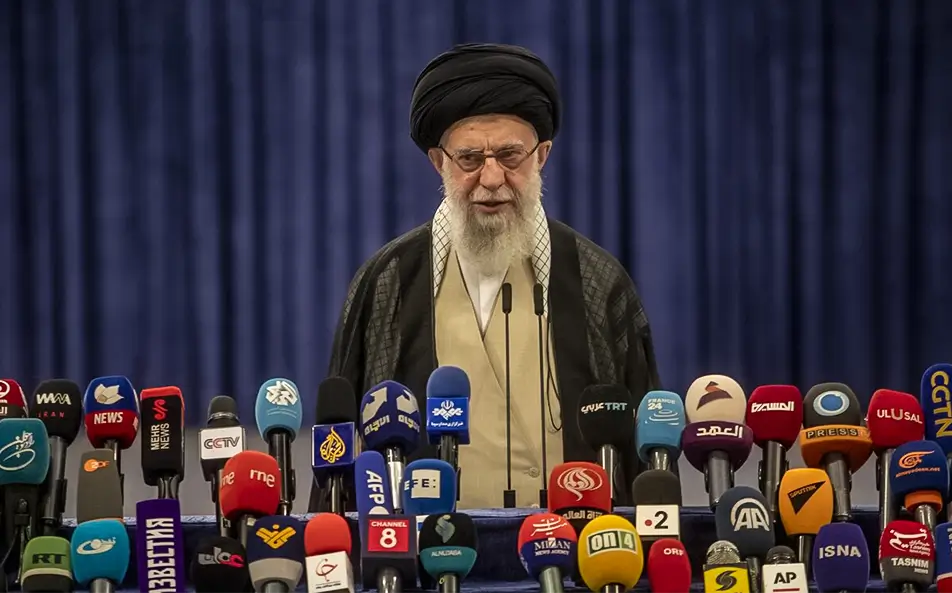
At the heart of the warning was the protection of Iran’s political and religious structure. Any threat to Supreme Leader Ayatollah Ali Khamenei, the president suggested, would be viewed not as a symbolic gesture but as a direct attack on the nation itself.
Within Iran’s political system, the supreme leader represents continuity and authority beyond elected office. By linking potential aggression to an “all-out war,” the message sought to raise the cost of any miscalculation.
Analysts note that such language is designed to discourage targeted actions rather than signal immediate retaliation.
Although the speech centred on foreign policy, it was clearly shaped by pressures at home. Iran is still struggling with rising prices, job losses, and growing public anger. Recent protests have highlighted how far official rhetoric is from the daily economic reality many Iranians face.
Without spelling it out directly, the president pointed to external pressure as the main reason living conditions have worsened. The argument that sanctions hurt ordinary people more than those in power has long been a key part of Iran’s messaging abroad.
By linking domestic hardship to foreign policy, the leadership appears to be trying to channel public frustration outward - focusing blame on external forces rather than on institutions within the country.
From Washington’s point of view, Iran’s remarks are not expected to lead to any immediate change in US policy. American officials have long tended to see such warnings as part of Tehran’s usual messaging rather than a signal of imminent action.
That said, the rhetoric does make diplomacy harder. It leaves less room for quiet engagement at a moment when back-channel talks are already shaky and regional relationships are under strain.
In that environment, even a small misreading of intentions on either side - could raise the risk of escalation, despite repeated public claims from both countries that they want to avoid a wider confrontation.
The implications of a broader conflict would not be confined to Iran and the United States. Neighbouring countries, shipping routes, energy markets, and proxy groups would all be affected by instability.
This is why regional actors tend to read Iranian statements carefully, separating posture from probability. For now, the emphasis appears to be on warning rather than action.
History suggests that both sides understand the cost of direct confrontation, even as they continue to test boundaries.
Despite the sharp tone, diplomatic channels have not closed entirely. Iran continues to signal openness to dialogue, though on terms that respect its sovereignty and leadership structure.
The challenge lies in rebuilding trust amid years of hostility. Statements like this one harden public positions, even as private discussions may continue elsewhere.
For diplomats, the task is to prevent rhetoric from becoming reality.
The speech should be read less as a declaration of intent and more as a strategic message. Iran’s leadership appears intent on deterring targeted actions while keeping broader conflict at bay.
Whether that balance holds will depend on choices made far from microphones and press briefings.
For now, the warning stands - clear, calculated, and aimed at shaping behaviour rather than provoking immediate response.
Warnings from Tehran illuminate how domestic pressure and international rivalry intersect. Understanding the context helps readers look beyond headlines to the risks of escalation-and restraint.
Everything you need to know
He said that any aggressive move targeting Iran’s top leadership would cross a red line and could lead to a wider military conflict.
While the warning was directed at Washington, it also serves as a signal to other international and regional actors involved in Middle East diplomacy.
Iran treats its senior leadership as central to state stability. Any perceived threat to it is framed as an attack on the country itself.
Such statements often come at times of economic pressure and public dissatisfaction, when the leadership seeks to project strength and unity.
Observers will look for responses from the U.S., changes in military posture, or renewed diplomatic engagement to assess whether tensions ease or rise further.


Oct 15, 2026
TUI Staff
Oct 15, 2026
TUI Staff
Oct 14, 2026
TUI Staff
Oct 15, 2026
TUI Staff
Oct 15, 2026
TUI Staff
Oct 15, 2026
TUI Staff
Oct 14, 2026
TUI Staff

Stay informed with independent, fact-checked journalism on technology, environment, government, economy and more. India’s most trusted digital news platform.


Comments (0)
Be the first to comment!