
Law and Order in India in 2025: From the Decline of Naxalism in India to the Rise of Cybercrime in India
Threats Are Changing
 IN
Mon, Oct 05, 2026 | 03:59 AM IST
IN
Mon, Oct 05, 2026 | 03:59 AM IST

Internal security in India has changed quietly. There was a time when large parts of the country were defined by red corridors, disrupted administration, and routine violence. In 2025, that picture no longer holds in the same way. Threats remain, but they are uneven, narrower, and often less visible.
What stands out today is not a single crisis, but a transition. Old challenges are receding. New ones are taking shape.
For decades, Left Wing Extremism shaped how the state functioned across central and eastern India. Roads ended abruptly, police movement was restricted, and basic governance struggled to reach remote villages. That phase has gradually faded. Open briefings from the Ministry of Home Affairs indicate that active extremist violence is now confined to roughly 45-50 districts nationwide.
Most of it is in southern Chhattisgarh now. Sukma, Bijapur, Dantewada, and Narayanpur still see problems now and then-some attacks, some weapons recovered. In Jharkhand, Odisha, Maharashtra, and Bihar, there are only small areas left, and they don’t really operate the way they once did. The present phase of Naxalism in India is no longer about territorial spread. It is about survival in shrinking spaces.
There was no single turning point. The decline came through years of steady work. Roads pushed into forest interiors altered movement patterns. Mobile connectivity reduced isolation. Security forces shifted tactics, placing greater emphasis on intelligence and coordination rather than large-scale operations.
Civil administration also began appearing more consistently. Health services, ration delivery, and welfare schemes reached areas that once saw the state only through security patrols. Rehabilitation and surrender policies provided exits for younger recruits. Over time, the space for armed groups narrowed.
Yet, this is not a closed chapter. Small armed units remain active in dense forest zones. Every few months, an ambush or encounter reminds authorities that the situation still demands attention. The difference is scale, not disappearance.
As violence in forest areas went down, cybercrime picked up fast. By 2025, reported cybercrime cases crossed 100,000 across the country, making it the fastest-growing form of crime nationwide. Financial fraud dominates these numbers.
UPI scams, phishing messages, and online gaming frauds have become routine complaints, particularly among younger users. Small businesses have also become frequent targets. Ransomware attacks have risen sharply, often leaving enterprises unsure of how to respond or where to report incidents.
Unlike physical crime, these offences have no clear geography. They do not require proximity or local networks. The rise of Cybercrime in India has exposed how traditional policing structures struggle to keep pace with borderless threats.
This shift has put pressure on how the system works-how officials are trained, how institutions respond, and how aware the public is. It has also forced the government to rethink what “security” actually means.
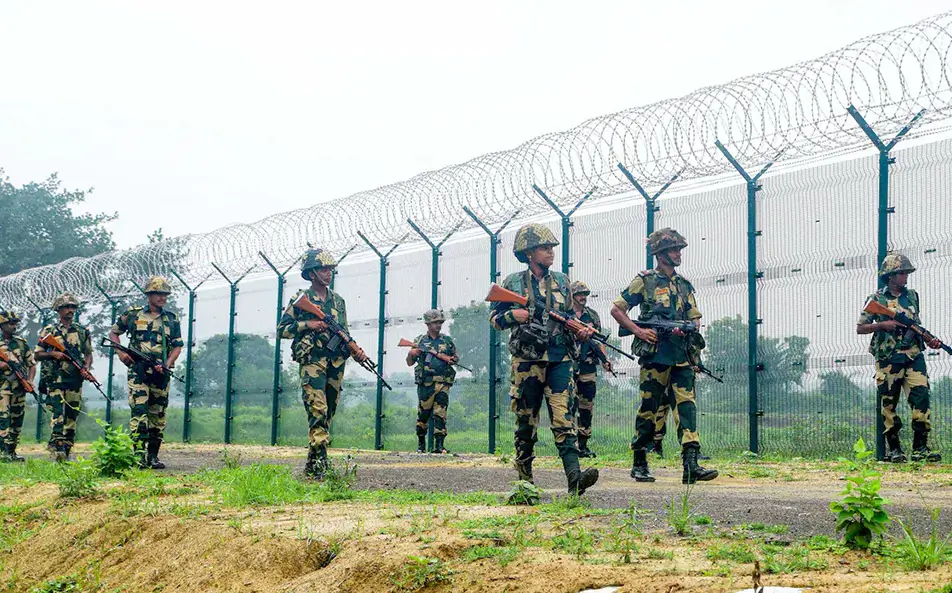
The northeastern states offer a contrasting picture. Insurgency-related incidents have declined by nearly 80 percent over the past decade. Peace agreements and political engagement have stabilised much of the region. Everyday security has improved in states such as Nagaland, Assam and Tripura.
Still, stability comes with caveats. The conflict in Myanmar has introduced new pressures along the border. Manipur and Mizoram require constant vigilance due to refugee movement and arms trafficking risks. Occasional arrests and recoveries continue, reflecting a region that is calmer, but still sensitive.
Here, internal security intersects closely with external developments, a reminder of how security management fits within the broader Indian political system.
India’s internal security story in 2025 is not one of crisis, but of adjustment. Law and order in India has improved by most traditional measures. Large-scale insurgency has receded. Governance has expanded. Coordination has strengthened.
At the same time, what we mean by risk has shifted. Today’s security challenges are shaped less by physical presence and more by technology-based crime, fragile borders, and how well intelligence systems actually work. The real issue is no longer about taking back land, but about keeping up with threats that change faster than the systems meant to stop them.
The United Indian examines governance, internal security and public policy through grounded reporting, offering clarity on how India’s challenges are changing on the ground.
Everything you need to know
It’s better in some ways and more complicated in others. Traditional threats like Naxalism have reduced, but newer challenges such as cybercrime and border-linked pressures are growing faster than expected.
Because even a smaller footprint can still cause serious damage. Violence is now limited to fewer districts, but those areas remain sensitive and require constant attention.
Because it’s easy to commit, hard to trace, and affects ordinary people directly. Scams, fraud, and ransomware don’t need physical presence, which makes policing them more difficult.
While old insurgent groups have weakened, new pressures have emerged from border instability and refugee movements. The region is calmer than before, but not risk-free.
It means security today isn’t just about guns or borders. It affects online safety, financial security, policing quality, and how quickly authorities respond to new kinds of threats.


Sep 23, 2026
TUI Staff
Sep 23, 2026
TUI Staff
Sep 19, 2026
TUI Staff
Sep 18, 2026
TUI Staff
Oct 03, 2026
TUI Staff
Oct 03, 2026
TUI Staff
Oct 03, 2026
TUI Staff
Oct 03, 2026
TUI Staff

Stay informed with independent, fact-checked journalism on technology, environment, government, economy and more. India’s most trusted digital news platform.


Comments (0)
Be the first to comment!