
US
Wed, Mar 04, 2026 | 01:23 AM IST

The United Indian

.webp?v=1772605415)


In the weeks leading up to January 26, activity around Kartavya Path has followed a familiar rhythm - rehearsals, coordination meetings, early morning drills. Yet those involved say something feels different this year. There is preparation without pageantry, movement without noise.
The Republic Day Parade in 2026 will be the first after Operation Sindoor, and that context quietly shapes every decision. There will be no overt references, no dramatic framing. Instead, planners have focused on tone - calm, deliberate, and controlled.
This is not a parade designed to impress at first glance. It is designed to be read carefully.
Veterans of past parades often describe them as grand, tightly choreographed displays of scale. This year’s rehearsals suggest a more restrained approach. Marching units remain precise, but transitions are slower, more measured.
According to officials involved, the goal is clarity rather than spectacle. The country, they say, does not need reassurance through excess. It needs confidence built on understanding.
That philosophy explains the parade’s structure - fewer abrupt shifts, more continuity, each segment flowing into the next.
At the heart of this year’s design is the debut of a Phased Battle Array. Unlike earlier formats that showcased equipment or units in isolation, this approach presents defence capability as a sequence.
The idea is simple: readiness is layered. Intelligence leads to coordination, coordination leads to mobilisation. Nothing operates alone. To the casual viewer, this may feel understated. To those familiar with defence planning, it communicates something important - preparedness is disciplined, not impulsive.
There will be no reenactments or commemorative displays linked to Operation Sindoor. That absence is intentional. Planners say the operation does not require celebration. Its significance lies in what it demonstrated: restraint, coordination, and controlled response. Those qualities are reflected in the parade’s pacing and structure.
The message is indirect, but unmistakable.
Despite its forward-looking tone, the parade remains anchored in memory. The sesquicentenary of Vande Mataram will be observed, though not as a standalone spectacle.
Instead, the song’s presence is woven into the programme, connecting different chapters of the nation’s story - resistance, independence, and modern statehood. It serves as context rather than centrepiece. In this way, history supports the narrative rather than competing with it.
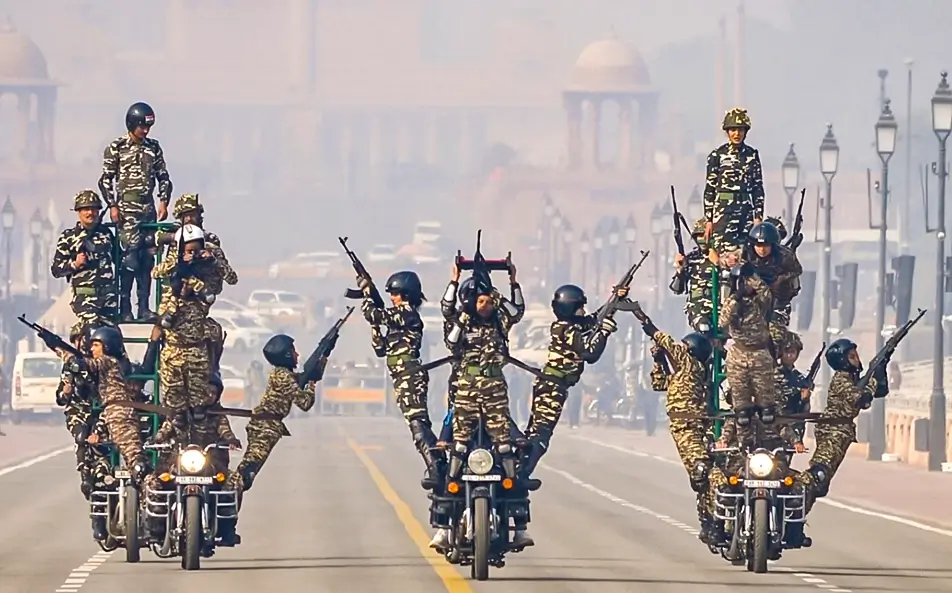
Veterans will feature more prominently this year, positioned not as symbols but as links between past and present. Their presence underscores continuity that today’s capabilities rest on decades of service.
The newly raised Bhairav light commando battalion will also make its first appearance. Its role is brief and understated, reflecting a shift toward agile, specialised forces suited to modern operational needs. Nothing about its presentation is dramatic. Officials insist that is the point.
<blockquote class="twitter-tweet">
<a href="https://twitter.com/DDNewslive/status/2014332525330792778"></a>
</blockquote>
Cultural tableaux from states will continue to be part of the parade, but they have been carefully integrated into the overall flow. Organisers resisted expanding these segments, choosing balance over excess.
The aim is to show diversity without distraction - reinforcing unity while maintaining the parade’s central narrative. This equilibrium between Cultural Heritage and preparedness has become more pronounced in recent years.
National parades are always read as messages, especially abroad. This one speaks softly. The emphasis on sequencing, discipline, and restraint presents Military Might as stability rather than threat. It avoids provocation, opting instead for assurance.
For international observers, the message is measured. For domestic audiences, it is reassuring without triumphalism.
Those who have watched decades of Republic Day celebrations say the difference lies not in what is shown, but in what is avoided.
There is no urgency to impress, no need to dramatise capability. The parade assumes a viewer willing to read between the lines. That confidence marks a subtle shift in how national ceremonies are imagined.
This R day parade arrives at a time when public rituals are expected to reflect reality, not just inspire pride.
The approach taken for Republic Day 2026 suggests an awareness of that responsibility. It favours explanation over excess, continuity over confrontation. The second and final mention of Army matters here because the institution is presented not as spectacle, but as system - integrated, prepared, and measured.
The United Indian covers national moments with depth and restraint, focusing on what public rituals reveal about how a country understands itself. We will continue to track preparations and decode what the 2026 Republic Day celebrations signal about India’s evolving national narrative.
Everything you need to know
Because it isn’t just about marching units and tableaux this time. The structure itself is changing, and that usually doesn’t happen unless there’s a deeper reason tied to security thinking.
Not necessarily. Officials say it’s more about readiness and realism than escalation. Showing preparedness doesn’t always mean expecting conflict sometimes it’s about avoiding it.
Some might, some won’t. To many people, it will still look like a familiar parade. But those who watch closely - especially veterans and analysts are likely to spot the difference in sequencing and emphasis.
Every Republic Day parade sends a message, whether stated or not. This one seems more measured - less about display, more about structure. That in itself is a signal.
Because it reflects how the country sees itself at a given moment. The order, the themes, and even what is left out often say as much as what is shown.
#weareunited
We respect your privacy. Unsubscribe at any time. Privacy Policy
Feb 27, 2026
TUI Staff
Feb 27, 2026
TUI Staff
Feb 17, 2026
TUI Staff
Stay Tuned with The United Indian!
Our news blog is dedicated to sharing valuable and pertinent content for Indian citizens. Our blog news covering a wide range of categories including technology, environment, government & economy ensures that you stay informed about the topics that matter most. Follow The United Indian to never miss out on the latest trending news in India.


.webp)

Comments (0)
Be the first to comment!