
End of Magh Mela Row? Shankaracharya’s Apology Demand Raises New Questions in Prayagraj
Faith Meets Authority
 IN
Tue, Oct 13, 2026 | 03:05 PM IST
IN
Tue, Oct 13, 2026 | 03:05 PM IST

Religious gatherings in India rarely remain confined to ritual alone. They carry memory, hierarchy, expectation and increasingly administration. When something goes wrong, even briefly, it does not stay local for long. That is what happened in Prayagraj this year, when a claim made by a senior Hindu religious leader turned a routine crowd-control decision into a national talking point.
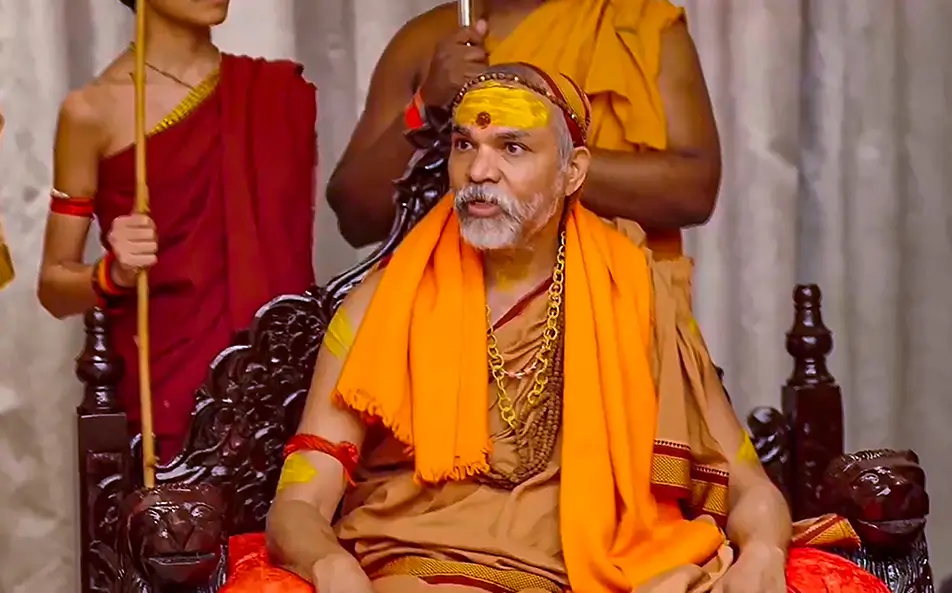
The allegation was simple, but loaded: the Shankaracharya of Jyotirmath and those accompanying him were stopped from taking a holy dip at the Sangam on Mauni Amavasya. Within hours, the incident was no longer about movement restrictions or security barricades. It had become a question of dignity, authority, and who decides access at sacred spaces.
At the centre of the controversy stood the Magh Mela, an event that has always walked a fine line between spiritual freedom and logistical control.
According to the Shankaracharya’s supporters, the religious leader arrived at the Sangam with the expectation of performing rituals customary to the day. They allege that authorities prevented the group from proceeding, citing crowd pressure and security concerns. Videos and statements began circulating, framing the moment as not just inconvenient, but disrespectful. The Shankaracharya later demanded an apology, arguing that the issue was not personal but symbolic. In his view, a tradition-bearing figure being halted at a sacred confluence signalled a deeper disregard for religious institutions.
The administration, however, told a different story.
Officials maintained that Mauni Amavasya was among the most crowded days of the festival, requiring strict regulation of movement. According to them, no individual or group was granted special access during peak hours. Their argument rested on safety: one exception could lead to many, and that could spiral into chaos.
From a bureaucratic standpoint, the decision was procedural. From a religious standpoint, it felt personal. That gap in perception is where the controversy found oxygen.
India’s religious leadership does not function merely as ceremonial authority. Figures like Shankaracharya Avimukteshwaranand represent continuity of lineage, interpretation and tradition. For followers, denying such a figure access during an auspicious moment carries symbolic weight, regardless of intent.
This is why the issue travelled far beyond Prayagraj. Discussions under Shankaracharya News were less about crowd management and more about whether religious hierarchies still hold relevance in a state-managed spiritual landscape.
Social media amplified the divide. Some users argued that faith cannot override safety. Others insisted that administration must understand the nuances of religious protocol rather than apply blanket rules.
The demand for an apology shifted the tone of the debate. It was no longer about explaining what happened, but about acknowledging how it was perceived. An apology, in this context, was less about blame and more about recognition.
Political leaders treaded carefully. Some framed the issue as miscommunication. Others warned against turning religious events into political flashpoints. Notably, there was no immediate attempt to escalate the matter legislatively, suggesting a desire to contain rather than inflame.
Still, the absence of a formal apology left room for speculation. Was the administration standing firm on principle, or avoiding a precedent?
Claims that the issue has ended depend on perspective. There has been no public confrontation since, and assurances have reportedly been given about better coordination in the future. On paper, that suggests closure.
But among devotees, the episode lingers. For them, it was not about one dip, but about the feeling that spiritual authority is increasingly subordinate to administrative convenience.
That discomfort does not disappear easily.
This is not the first time such tension has surfaced, and it likely will not be the last. As religious gatherings grow larger and more regulated, friction becomes inevitable. Ancient traditions operate on symbolic timing and hierarchy. Modern governance operates on risk assessment and crowd modelling.
When those logics collide, neither side feels fully understood.
The second and final mention of Magh Mela belongs here - not as a festival, but as an example of how faith now exists within frameworks it did not originally imagine.
Administrations may respond by tightening protocols further, while religious leaders may demand clearer assurances of access and respect. Both approaches carry risks. Too much rigidity alienates belief. Too much flexibility threatens safety.
The real challenge lies in communication not after incidents occur, but before.
At The United Indian, we see this episode less as a clash and more as a symptom. Faith in India has never existed outside public life. But public life now runs on systems that faith was never designed to navigate.
The Prayagraj controversy reminds us that governance is not only about order. It is also about understanding what moments mean to those who believe especially when no offence was intended, but one was deeply felt.
Everything you need to know
It’s one of the most important and crowded days, so any restriction on that day feels far more serious than on others.
That depends on who you ask. Supporters say it was denial. Officials say it was a temporary restriction due to crowd pressure.
Possibly. Better communication in advance might have avoided confusion and hurt feelings.
Because senior religious figures are traditionally given symbolic respect during rituals, especially on significant dates.
Yes. Large gatherings have real risks, and authorities are expected to prevent situations from turning dangerous.


Oct 09, 2026
TUI Staff
Oct 09, 2026
TUI Staff
Oct 09, 2026
TUI Staff
Oct 09, 2026
TUI Staff
Oct 09, 2026
TUI Staff
Oct 09, 2026
TUI Staff
Oct 09, 2026
TUI Staff
Oct 09, 2026
TUI Staff

Stay informed with independent, fact-checked journalism on technology, environment, government, economy and more. India’s most trusted digital news platform.


Comments (0)
Be the first to comment!